
Black Soldier Fly: Ten Years of Turning Organic Waste Back into Protein
In 2014, Hu Wenfeng made a decision that seemed somewhat “unorthodox” at the time: using black soldier flies to treat organic waste.
That year, he led the Shenzhen technical research project “Key Technology R&D for Resource Utilization of Organic Waste.” The team started raising dark-colored larvae in a small workshop in Pingshan—this insect of the Stratiomyidae family, scientifically named Hermetia illucens, reproduces quickly, has a broad diet, and boasts high conversion efficiency. It can consume food waste, livestock and poultry manure, and agricultural waste, turning them into high-value insect protein.
This technological path was not easy. Black soldier fly breeding, self-reproduction, large-scale farming, microwave drying, and defatting to extract oil—every single step had to be figured out from scratch. The team plunged into the workshop and worked there for three years straight.
In 2017, two milestones were achieved simultaneously:
First, the industrialization and large-scale production of black soldier flies were realized; Second, dried black soldier fly larvae were exported to the United States for the first time—a national first.
From a single larva to an entire industrial chain, the key milestones are laid out as follows:
- 2014: Initiated research on using black soldier flies to treat urban organic waste (a project of the Shenzhen Science and Technology Innovation Commission).
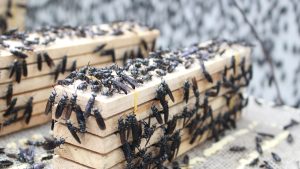
- 2016: Overcame the technologies across the black soldier fly industrial chain and broke through the bottleneck in reproduction technology; the egg production of black soldier flies reached more than 10 times the international level.
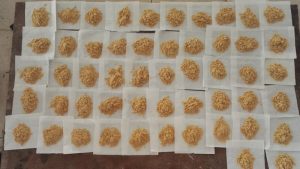
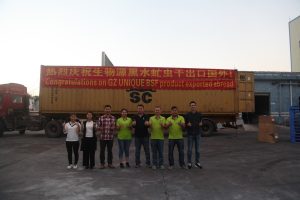
- 2017: Dried black soldier fly larvae were exported to the US for the first time, achieving industrial mass production.
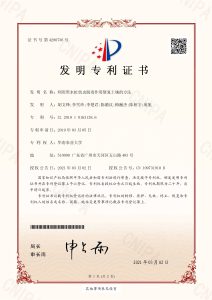
- 2018-2022: Developed patented technologies such as harmless treatment of antibiotics in livestock and poultry manure and soil detoxification; participated in the formulation of industry norms and quality standards.
- 2021: Led the Shenzhen technical research project “Breeding of High-Performance Black Soldier Fly Strains and Establishment of a Germplasm Resource Bank”; in the same year, CCTV’s Focus Report (Jiaodian Fangtan) visited BioSource.
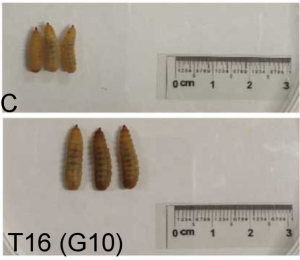
- 2022: Established the Insect Business Division, advancing insect industrialization.
- 2023: Dried crickets were exported to the US; launched a black soldier fly frass fertilizer specifically for tobacco.
- 2024: The Malaysian subsidiary iProtein was established; co-hosted the “First International Symposium on Feed and Food Insects and Sustainable Food Safety Solutions” with South China Agricultural University.
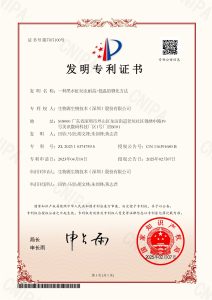
- 2025: Patents were granted for stress-resistant black soldier fly germplasm resources and functional insect protein; long-distance transportation technologies for black soldier fly eggs and larvae were granted patents in China and the US, respectively; co-hosted the “Second International Symposium on Feed and Food Insects and Sustainable Food Safety Solutions” with South China Agricultural University.
- 2026: Established the ™Black Soldier Fly brand, moving towards industrial branding; participated in the formulation of the T/CFIAS5015—2026 group standard for dried black soldier fly larvae; co-hosted the “Third International Symposium on Feed and Food Insects and Sustainable Food Safety Solutions” with South China Agricultural University.
Today, BioSource’s insect product line covers six major categories: microwave-dried larvae, hot-air dried larvae, defatted larvae meal, larvae slurry, insect oil, and frass fertilizer, serving the aquaculture, poultry, and pet markets. It is no longer just “farming bugs,” but a complete closed loop from organic waste to alternatives for fishmeal and soybean meal.
Because we believe in one thing: insects are not just insects; they are the bridge that turns “waste” back into “protein.”